

When you start out in coaching, someone will come in and talk to you about skills and technique and drills.
And the traditional model goes something like this:
Introduce a new skill. Demonstrate it. Get the kids to try it. Make it fun. Make it interesting. Get them engaged.
Then — once they understand the movement — get them to do it over and over and over again until they “master” the technique.
There’s nothing wrong with repetition. If you’re learning piano or engineering or art — where you need to do the same thing precisely, in the same environment, over and over — mastery makes sense.
But sport isn’t like that.
The Problem With “Mastering the Movement”
Human beings are not robots. And competition is not a controlled environment.
In competition, athletes have to execute skills:
Against other human beings
At high speed
When they’re tired
When they’re under pressure
In unfamiliar conditions
Consistently, over and over
In other words — they have to do the skill when and where it really matters.
And here’s the problem with the traditional model:
We teach kids to do the skill. We get them to repeat it until they can do the movement well. But we don’t progress them through to being able to do it in competition conditions.
We master the movement — but we never transfer it to performance.
The Performance Practice Model
Here’s what I suggest instead.
Once they can do the skill reasonably well, start adding layers.
Layer 1: Speed
Can they do the skill at high speed?
I don’t know many sports where you win gold medals by doing things really, really slowly. Add speed into your drills early.
Layer 2: Fatigue
Can they do the skill at speed when they’re tired?
Most sports are decided in moments of fatigue — either exposing it in the opposition or executing in spite of it yourself.
Layer 3: Pressure
Can they do the skill at speed, when tired, under emotional pressure?
State championships. School finals. Nationals. Grand final. The crowd. The moment.
Layer 4: Consistency
Can they do it over and over?
Most sports — especially team sports — require athletes to execute repeatedly across 40, 60, 80 minutes. Not once. Continuously.
Layer 5: Competition
Can they do all of the above in a real competition setting?
The Tuesday Night Trap
Here’s the classic scenario.
You’re training kids at home. It’s Tuesday night. Nice and quiet. Controlled conditions.
And you think — wow, this kid can really do that technique well.
Then you take them to state championships.
They get no sleep because they’re sharing a room. They eat junk food for breakfast because nothing else was open. The warm-up pool is crowded and chaotic. It’s pouring rain. Freezing cold. Their family isn’t there.
And they’ve still got to perform the skill — reasonably well, at speed, under fatigue, under pressure, consistently, in competition.
That’s the real test.
Break Free of the Old Model
I want you to challenge this idea of “mastering the movement.”
Yes — it’s important that athletes learn to do things well. But don’t be obsessed with perfection. There is no such thing as perfect technique.
What matters is whether they can execute skills that work for them — when and where it matters.
And we do that by progressing drills through:
Speed
Fatigue
Pressure
Consistency
Competition conditions
That’s Performance Practice.
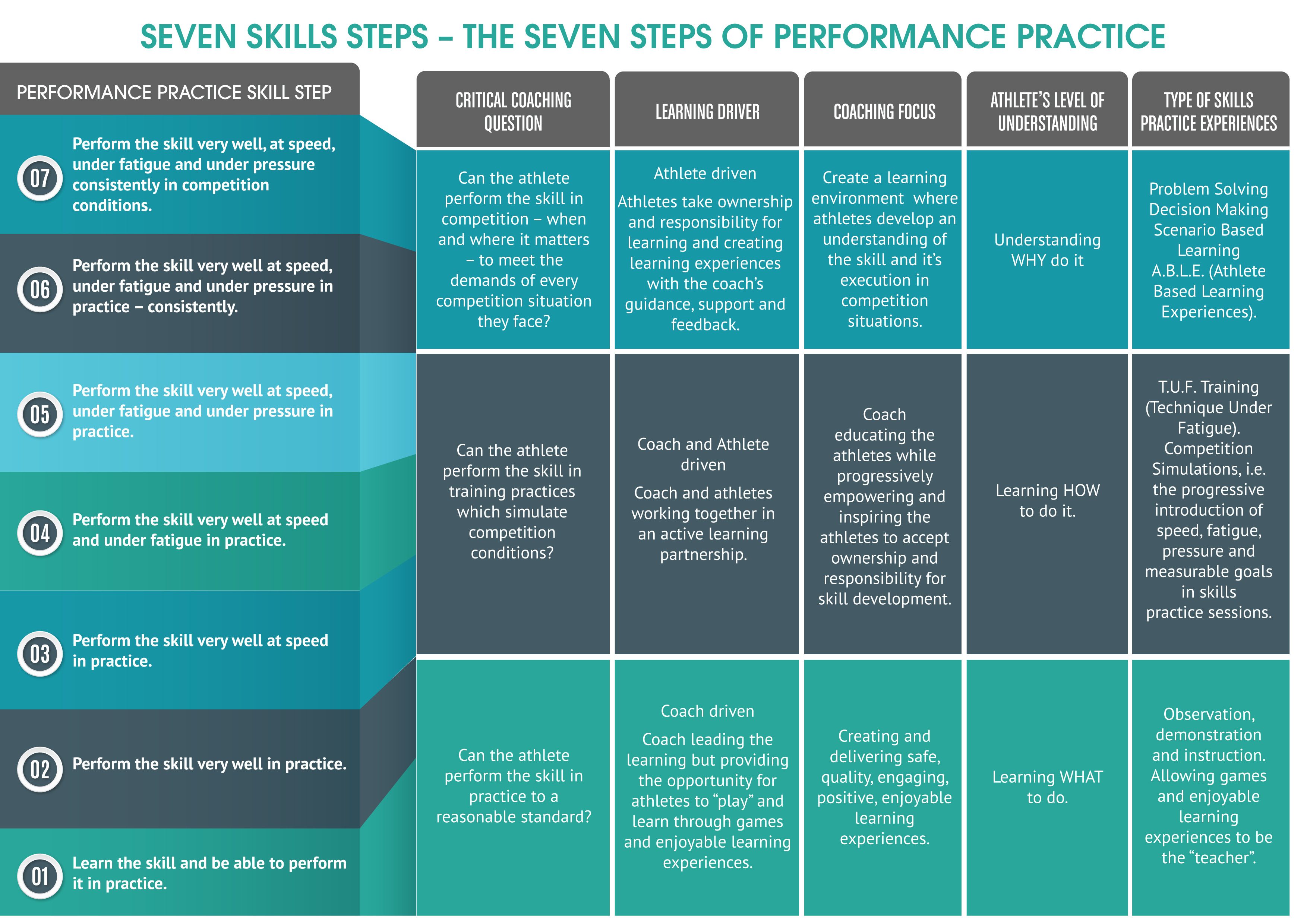
The Seven Skill Steps
I’ve put together a simple handout on the seven steps of skill progression — from learning the movement through to executing in competition.
Over to You
How do you teach skills?
Do you progress your athletes beyond mastering the movement?
What do you do to prepare them for the pressures of competition?
I’d love to hear from you. Drop a comment below.
Wayne Goldsmith


