
You're Not Good Enough.
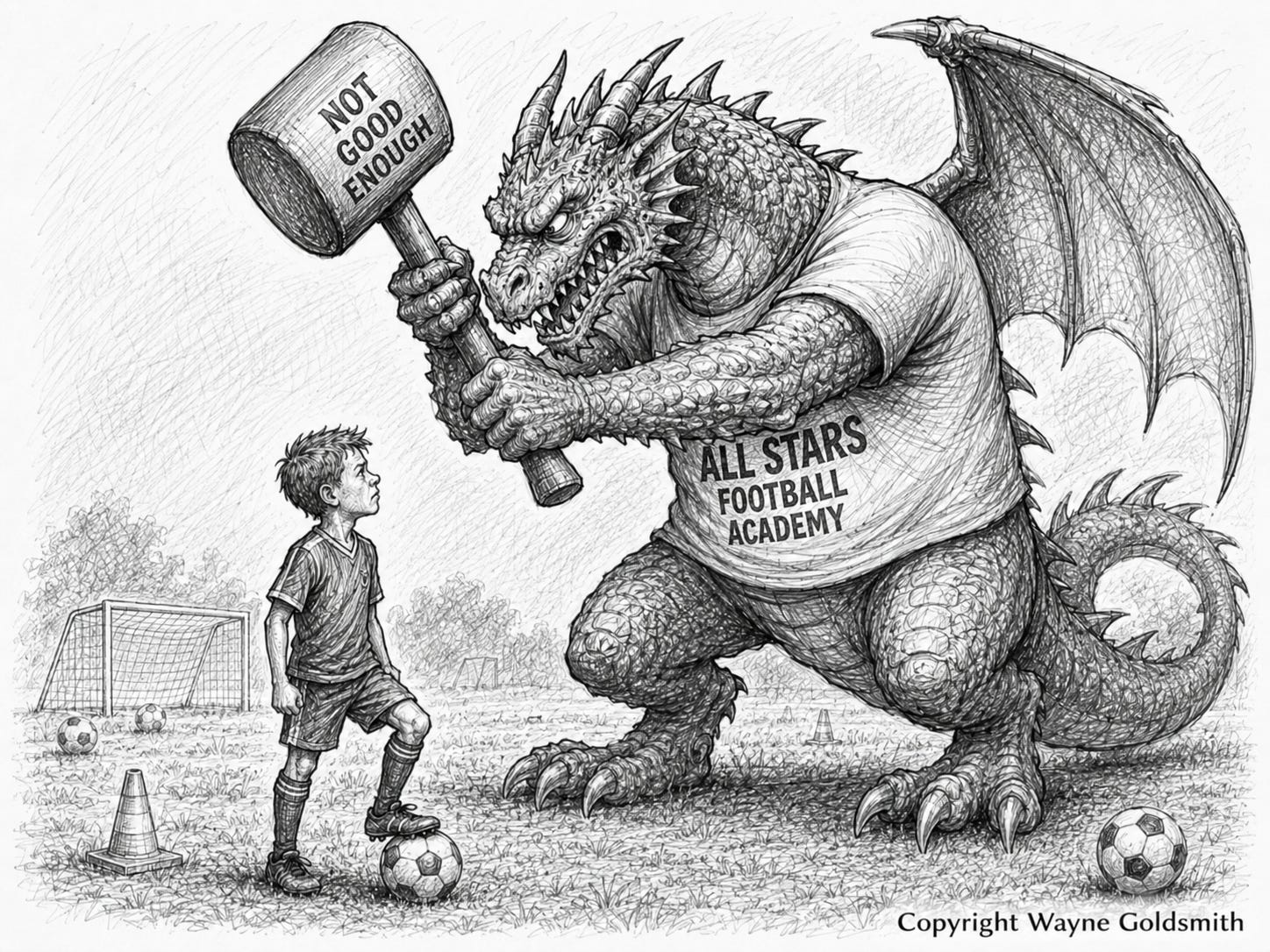
The four words we say to 12 year olds that should end a career - the coach's, not the kid's.

By Wayne Goldsmith
By Wayne Goldsmith
Three important messages:
No adult should ever tell a child they’re not good enough to make it.
A “no” at 12 is a snapshot, not a verdict - and kids can’t tell the difference.
How you deliver bad news to a young athlete matters more than the news itself.
You’re Not Good Enough:
This morning I was enjoying a coffee and listening to a FIFA World Cup update.
There was an interview with a young player who’d just finished his first ever World Cup game. The reporter asked him about his journey.
What he said stopped me mid-sip.
“When I was 12, I was told by two of the leading football academies in my city that I was not good enough to make it to the top in football.”
Twelve years old. Told by the so-called experts that he didn’t have it.
And there he was - playing at a World Cup.
Let me say this as plainly as I can.
If you’re a coach, an academy manager, a parent or anyone associated with sport, and you can look into the eyes of a 12 year old and tell them “you’re not good enough to make it in this sport” - do us all a favour.
Get out of the industry.
Not every child can make every team. Selection is part of sport. There will always be a squad that’s picked and kids who miss out, and pretending otherwise helps no one.
So this isn’t about never giving a young athlete a “no”.
It’s about the words you wrap around that “no”.
“You’re not good enough” isn’t feedback. It’s a verdict. It’s final.
It tells a child that the door is closed, that the thing they love isn’t for them, that some adult with a clipboard has seen their whole future and decided it doesn’t include the game.
And a 12 year old can’t tell the difference between “not good enough today” and “not good enough ever”. They hear the second one. Every time.
We’ve worshipped early physical talent for so long that we’ve forgotten the cornerstone of what junior sport is actually for: inspiring the hearts and minds of young people to believe in themselves and their dreams.
Are some kids better than others at 10, 12, 14? Of course.
But the early developer is not the finished article.
The kid who’s small at 12 might be the strongest in the room at 18.
The late bloomer we cut today is the one who comes back to haunt us.
We are, over and over, terrible at telling which 12 year old becomes the 25 year old champion - so why on earth do we keep slamming the door as though we know?
Three things to say instead:
So here’s the practical part. Next time you have to deliver hard news to a young athlete, throw “you’re not good enough” in the bin and reach for one of these instead.
“You haven’t made the cut today - and today is the key word.” Make the timeframe small and specific. Not “you didn’t make it”. You didn’t make it this time. One squad, one season, one selection. Leave the future wide open, because the truth is you don’t know what it holds.
“Here’s what I saw in you that I loved.” Then give them something real. Their work rate. Their first touch. The way they never dropped their head. A child can walk away from a “no” if they’re also walking away with something to be proud of and something to build on. Send them off with a strength, not just a rejection.
“This is a setback, not the end - and what you do next is up to you.” Hand them the way forward. What to work on. When the next opportunity is. That the best players in the world were all cut, dropped and overlooked at some point and came back stronger. Turn the door they think just closed into a door they get to walk back through.
None of this is soft. It’s not about pretending every kid is brilliant or that everyone makes the team. It’s about understanding that how you deliver the news lands harder and lasts longer than the news itself.
You can tell a child they didn’t make it today and still leave them believing they can do anything.
That’s the job.
Summary:
I hope that young footballer goes on to be the next Messi or Ronaldo. I hope he scores 1000 goals.
And I quietly hope he one day names the academies that told a 12 year old he wasn’t good enough - not for revenge, but as a reminder to every adult in sport of the damage four careless words can do.
Because somewhere this morning, a kid was told they’re not good enough.
And we may have just talked the next great player out of the game - over breakfast, in a car park, with four words that we could so easily have chosen better.
Choose better.
Three Practical Applications For Your Coaching:
Ban the phrase. Make “you’re not good enough” words that are never spoken in your club or program - by any coach, to any child, ever. Replace it with “not this time”, and make it a standard everyone signs up to.
Never deliver a “no” without a strength. Train every coach who selects to pair every piece of hard news with something genuine the child did well and can build on. The rejection and the reason for hope land in the same conversation.
Coach the parents too. The “you’re not good enough” message often comes from the sideline, not the coach. Help your parents understand the power of their words after a setback - and point them to people who can help them get it right.
Want to raise a child who loves sport for life - and who can bounce back from any setback the sporting world throws at them?
That’s exactly what my Raising Athletes course is built for. No hype, just practical guidance for sporting parents: https://coachwayne.gumroad.com/l/raisingathletes
And for more like this every week - coaching, talent and the truth about developing young athletes - subscribe free to Sports Thoughts: https://waynegoldsmith.substack.com/
Thanks for reading, listening and watching.
Wayne
This message cannot be repeated enough. Thanks for putting the topic back on the table.